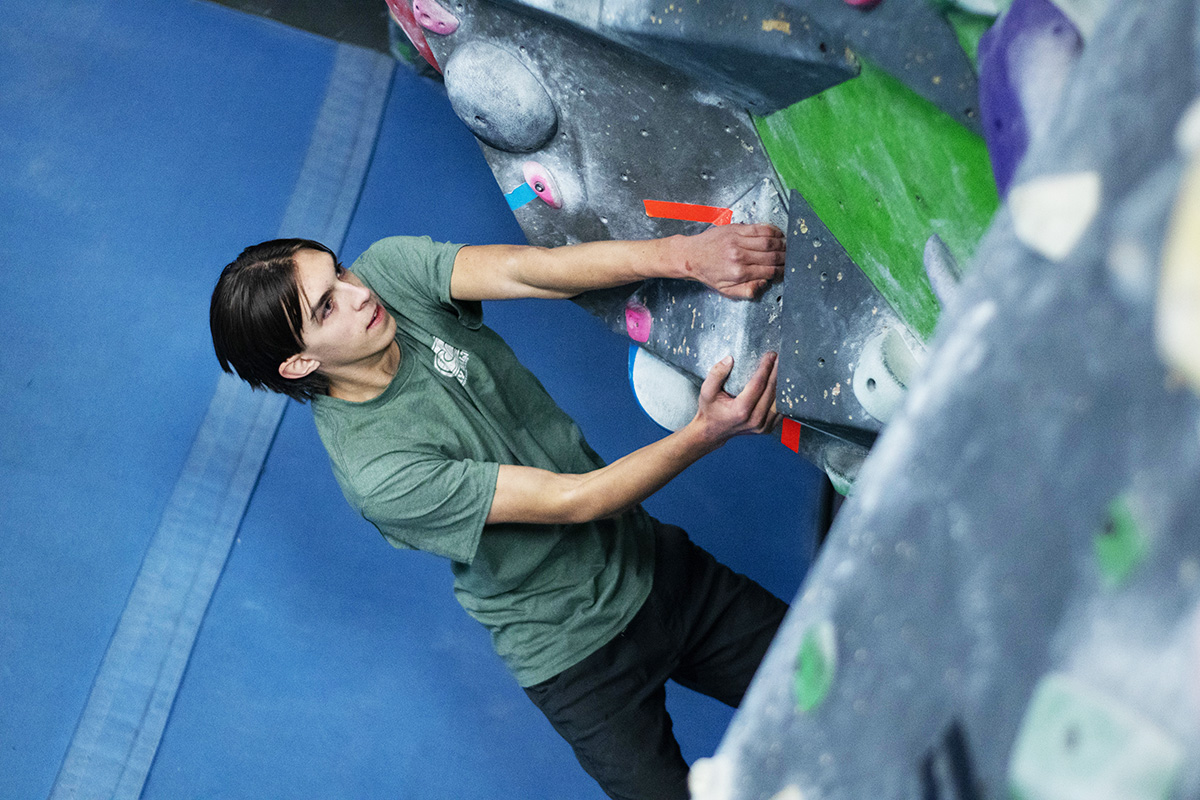
Sloan Robertson grips the bouldering wall at Coulee Climbing in Lethbridge on Nov. 19. Photo by Lenna Isleifson.
The phrase “you’re driving me up the wall” takes on a whole new meaning as soon as you step inside a climbing gym.
Every day, climbers of all shapes and sizes brave blisters, bruises and scrapes for the thrill of reaching just a little higher, holding on a little tighter and leaping a little farther.
At Coulee Climbing, a bouldering gym in Lethbridge, up the wall is the best place to be.
“Especially if it’s a [higher] grade than you’d normally climb, or one that you’ve tried really hard and you just finally found the piece that clicked to complete it, it’s just so rewarding. It really makes you want to keep going,” says Sloan Robertson, a student at Lethbridge Polytechnic and recreational climber at Coulee Climbing.
Bouldering is a form of rock climbing that doesn’t rely on ropes or harnesses, focusing on shorter routes and dynamic movements.
Routes are marked by coloured plastic holds with the starting position and difficulty indicated by coloured tape.
As a kid, Robertson says he loved climbing everything he could and stumbled across videos on YouTube that launched him into bouldering as an adult.
“I just love the feel of it. You know, it’s fun exercise.”
Dominic Kwasni is part of the staff team at Coulee Climbing. He says bouldering is great for the people looking for a more creative way to stay active.
“They don’t want to work out. They don’t want to run. They really want to get into something that challenges their brain as well and not just their physical side.”
While bouldering, climbers can find themselves hung up on the puzzles within each route.
“You climb for like 10 to 30 seconds and then you take a five-minute break, and then you figure out a puzzle. It’s a lot of problem solving and a lot of thinking before you get on the wall.” Says Kwasni.
For Robertson, that intellectual challenge has been something that keeps him coming back.
“[There’s] a really strong connection between the physical and the mental parts of climbing because every route is a puzzle and there’s physical and mental components to each. I just don’t see it as strongly in any other sport.”
But hanging out on a bouldering wall isn’t just good for your brain and your body, it’s also good for social connection because it comes with crowd to hang out with.
Kwasni was introduced to climbing five years ago when his best friends got involved with it. He says the people he has met since then have become a core part of his life.
“I met a lot of people here that I’ve never seen in my life, I’ve never talked to in my life, and they ended up becoming really good friends. I have a couple friends now that I know I’ll be friends with for life just because at one point we climbed together.”
It’s not just in this city, or this gym either. Kwasni says climbing wouldn’t be the same without the kinds of people it attracts.
“I think the community is the biggest reason why people climb. Climbing is a lot of fun, but it would not be the same without this specific community.”
As a former student, he says the connections he made while climbing also helped him find friends on campus.
“A lot of professors climb here. So, it helped me become more intertwined with the university group too.”
Robertson has experienced that same welcoming environment in his first couple months of regular climbing. He says the people are what set the sport apart.
“I’d say it’s one of the best sports for a welcoming community because I have never had a bad encounter with somebody at a climbing gym. And yeah, people are watching you, but a lot of the times it’s for their own learning and even to help you.”
Community is the key to success, according to Robertson.
“It’s awesome going over a problem that’s really hard to find the solution for because with the with a group of people you can put your minds together and each try the climb. And as you’re watching somebody else do it, you notice a lot of things that you wouldn’t by yourself. It’s just that encouragement to keep trying”
The popularity of climbing, especially in young adults and students, has increased exponentially in Canada over the last five years, bolstered by its inclusion in the 2021 and 2024 summer Olympics.
According to a study by Grand View Horizon, the Canadian climbing gym market is expected to grow at a compound annual growth rate of 7.2 per cent from 2025 to 2030.
Kwasni says that during his time at Coulee Climbing the gym has only been getting busier.
He points out that it’s particularly appealing to students because, like other gyms, it’s open early in the morning and late into the evening, making it possible to fit a climb in before or after classes.
He says fear about how others would see him was something that held him back in the beginning, but that nobody should hesitate to give it a shot.
“I think it is the most accessible sport, or one of the most accessible sports at least, and I think everybody should at least give it a try.”
His advice for newcomers is to not be afraid to look silly, because the best climbers are the ones who fall most often.
In Lethbridge, both Coulee Climbing and Ascent Climbing (which offers lead and rappel climbing as well as bouldering) offer lessons and host events throughout the year.