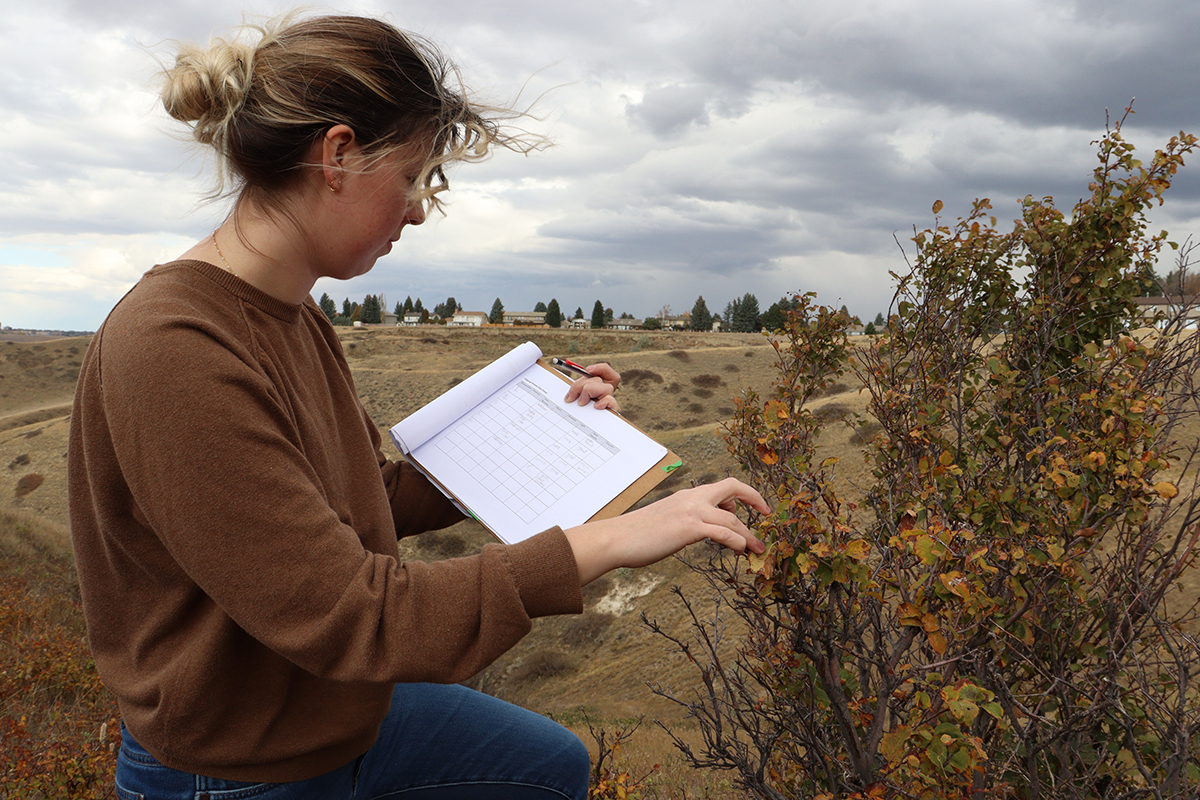
Courtney Ross, Lethbridge Polytechnic renewable resource management student participates in a field study for plant identification in the Lethbridge coulees. Photo by Hailey Slovack.
Lethbridge Polytechnic’s renewable resource management program is providing students with industry opportunities through regular field studies. These trips take place around southern Alberta, giving students an idea of their future work environment.
Throughout the autumn months, students are bused from Lethbridge Polytechnic to locations set up to imitate real-life scenarios faced in the workforce. They are taught industry skills through plant identification, wildlife tracking, habitat assessment and fishery monitoring.
“It gives me more experience to actually know what I’m learning and know how to do it, rather than just doing theory and lectures,” explains Courtney Ross, program student.
Ross feels these trips are helping her prepare for her career. She mentions through the hands-on learning, she can bring her knowledge back into the lectures. She also finds the studies to be one of the best highlights of the program, giving her experiences outside of the classroom.
Mark Klassen, botany professor at Lethbridge Polytechnic, believes the trips are a fundamental part of the students’ education. He says students are learning the skills to help them both in the classroom and their future careers.
He explains what the students are learning through hands-on experiences are being applied to labs and lectures. He feels this helps the students have a better understanding of what they are learning.
“So that’s kind of the most important thing, I think, is that they’re learning the skills they need,” says Klassen. “Whether that be plant (identification) or range assessments, all are important skills.”
Klassen also mentions that field studies have been an ongoing factor of the program long before he started teaching. He believes they are one of the biggest selling points for students interested in the environmental sciences.
“I’ve been teaching here for 19 years and I was a student here probably 23 years ago. I was going on field trips then,” says Klassen.
Field studies are not the only way students are getting hands-on learning. Ross mentions the resources provided for the students are also helping her feel more confident in her journey to prepare for industry expectations.
“All of the tools we use,” explains Ross, “is stuff that we would use in our jobs in the field.”
In addition to the industry tools and field studies, Renewable Resource Management students also have access to one of Canada’s largest collections of full-body taxidermy mammals. The Hubbard Collection contains over 100 specimens available on display for students. The polytechnic is also home to an on-campus greenhouse, open to students for their studies. Both Ross and Klassen believe that the combination of these resources and field studies are imperative to the success of the students.