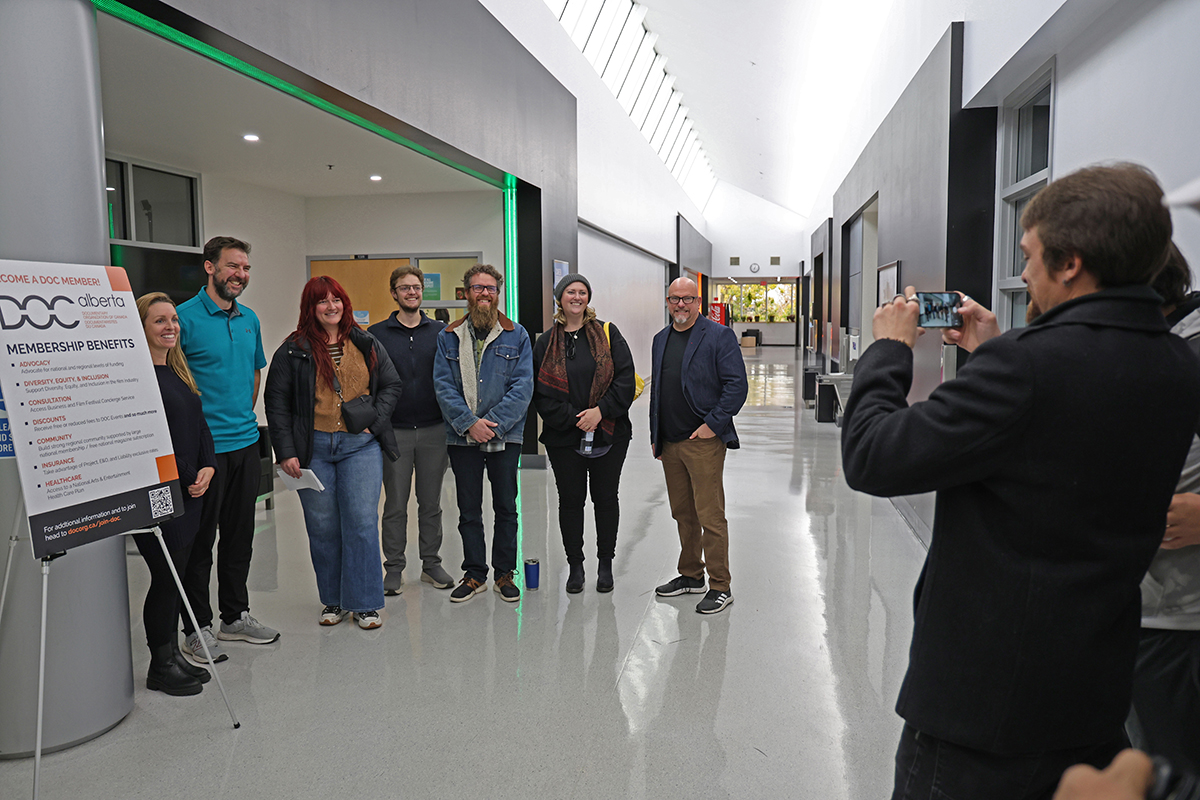
From left to right, Jenna Bailey, Kris Hodgson-Bright, Annie Stehr, Sean Kjos, Charlie Christensen, Gianna Isabella Magliocco and Kelly Wolfert wrap up after a successful campus visit on the afternoon of Oct. 14 at Lethbridge Polytechnic. They came to share their love for film. Photo by Kerr Abueva.
Lethbridge’s film industry continues to inspire as it welcomed back a local filmmaker now working internationally.
Filmmakers met with students at Lethbridge Polytechnic in mid-October, where the team of Kelly Wolfert, Documentary Organization of Canada Alberta board chair, Gianna Isabella Magliocco, a Venice, Italy based filmmaker and director, Charlie Christensen, vice president of the Lethbridge Independent Film Society, Annie Stehr and Sean Kjos who are directors of the Lethbridge Independent Film Society plus Jenna Bailey, historian, writer, documentary filmmaker met with to celebrate both local and global achievements in creating amazing content that has made it to the big screen.
At Theoretically Brewing Company in Lethbridge, the evening social event gave audience the chance to ask the renowned filmmaker about her journey in the industry. This is one way for Magliocco, who lives in Venice, to share her personal experience during her short return to Lethbridge for inspiration.
“I started out in narrative, so I was inspired by films,” said Magliocco. “Initially, I actually saw a documentary about basketball in time that I just really loved. I just started finding them by myself at the library. I also had a class at the university at that time to present a very interesting documentary called The Five Abstractions.”
Magliocco built a love for film. As she was working on movies like Interstellar, The Revenant, Lewis and Clark, Damnation and Cold Pursuit, she realized she could direct a documentary. She started with her family as they are immigrants based in southern Alberta and originally from Ireland. She really wanted to tell their story.
Stehr says she is inspired by her love of consuming films, seeing great storytelling and watching stories be told.
“I got started because of my mom, as she was a great photographer,” Stehr said. “I have her camera and I shoot on that. I have always loved films and I have loved photography.”

Both shared their biggest challenges in the film industry. For Magliocco, she encourages any budding filmmaker to advance their skills as it takes a while to develop. One must also make sure they are finding time to meet people through networking and other opportunities that present themselves.
“The last thing is that the things you don’t learn are actually the things that make it harder,” Magliocco added.
Learning about how to build an audience before starting is something Magliocco has learned about herself on her journey. It is something that has been a challenge on her part, because not a lot of people talk about focusing on it. Thus, the information is not always out there.
In Stehr’s perspective on the other hand, she says one of the biggest challenges she has seen is imposter syndrome and not thinking she’s able to do what she wants to do and letting that fear of failing get in the way of starting.
“I think the best way for people to kind of get over that is to build a network of other like-minded individuals that inspire you,” she said. “These people are doing inspiring things to help push you out of that safe zone and into that discomfort of maybe you might fail and keep doing more.”
In dealing with these challenges, both gave top skills and qualities to make a better film. Stehr says it is adaptability. One must be able to be adaptable to anything you are doing. She says nothing is going to go exactly the way you hope it is going to go. And being able to pivot on obstacles you are going to face in the process is going to get you where you need to in the end.
“I think having a good, hard-working attitude is also one so you can continue to network with people and like in those moments when you need to pivot,” Stehr said. “You have people that you can rely on, and they want to work with you because you have that positive, kind of light about you.”
Magliocco says communication is the biggest skill to build on. In communication, if you are working with someone who is the subject of the documentary, you still must get a performance out of them even if they don’t know how to go about it.
“I don’t mean they’re going to act like they are in a theatre or something like that, but that they’re going to give you the honest answer,” she added. “They’re going to tell you the truth.”
For Magliocco, one must earn the trust of an actor for them to really open up, because if they don’t open up, they are just going to look wooden and they will not trust you with their story.
Another biggest skill is the ability to connect with others. For her, it is how to communicate with somebody and also be able to open up yourself to others as well. Because if you open up to that person and you make yourself a little bit more vulnerable, they are more likely to also be vulnerable.
“Meet people, come to events like this and introduce yourself,” Magliocco advised. “Keep doing what you’re doing and understand that you’re not going to make money right away and that’s okay.”
Magliocco says to continue to build a portfolio around projects one cares about. If a person takes on work they do not enjoy, especially for free, it is never going to be fun or fulfilling. But if one pursues something genuinely interesting, there is always a desire to see it succeed.
“Build networks and support your friends’ projects with a positive attitude that people will keep bringing you in,” Stehr added.
She also encourages students to be open to new roles, even if they have not performed before. She advises doing this through research and preparation to avoid going in unprepared. If a script is received, it should be read. If a call sheet is provided, it should be studied. And if something is unclear, one should ask questions and collaborate, as this is the best approach to success.
You can next catch all filmmaker enthusiasts for another gathering on the last week of each month. You can learn more details by signing up for their mailing list on their website: lifs-ab.com. To learn more about Doc Canada and the Alberta chapter, check out more details here: docorg.ca.