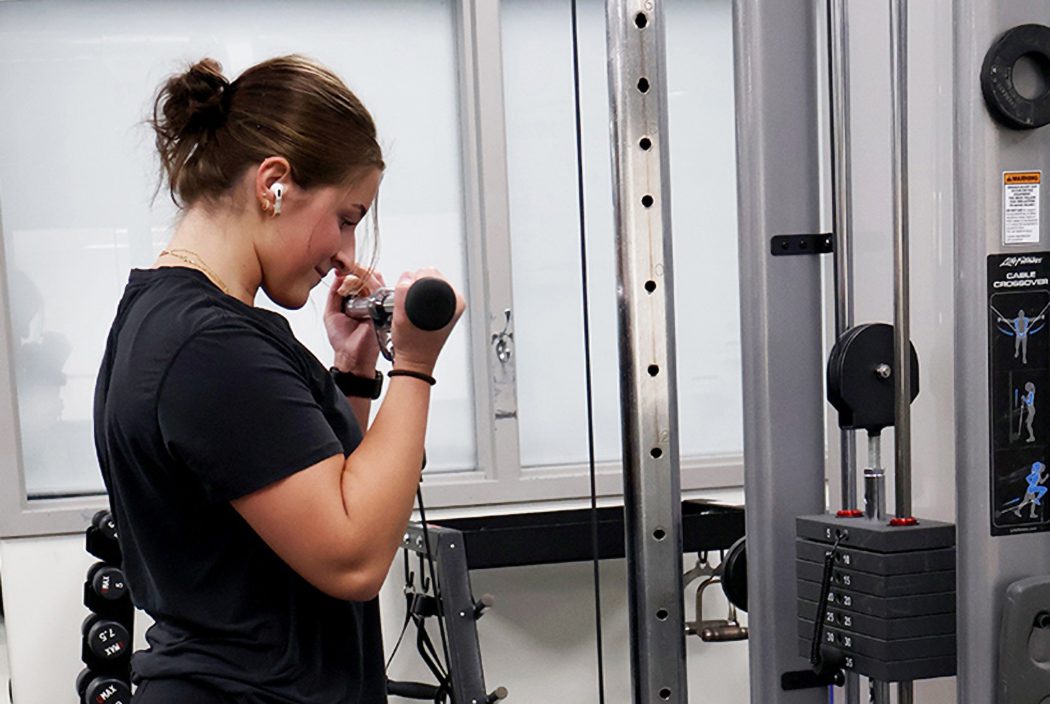
Halie Stockman performs biceps curls on a cable machine in the fitness centre at Lethbridge Polytechnic. She says regular exercise helps her maintain her overall well-being. Photo by Patience Omeruo.
At the age of 15, everything changed. A traumatic injury forced her to give up the one thing that had defined her life: dance. She was left searching for a new sense of purpose. The gym, once just an occasional activity, became something more. It became a place where she could rebuild, regain control and rediscover her confidence. This was the turning point for Halie Stockman, a student at Lethbridge Polytechnic. What started as recovery turned into routine and eventually into a lifeline.
Stockman describes exercise as essential to her well-being.
“Dance was my entire life growing up. And then after my accident, the gym was my purpose. It just kept me going. It was really good for me because it was good for my mental health,” said Stockman.
According to an article on physical activity published by the World Health Organization on June 26, 2024, regular physical activity is associated in adults with “reduced risk of all-cause mortality, risk of cardiovascular disease mortality, incident hypertension, incident site-specific cancers, incident type-2 diabetes and improved mental health.” Yet nearly one-third of adults worldwide, around 1.8 billion people, are physically inactive.
Getting started is often the hardest part. Many people feel intimidated or unsure of where to begin.
Cheryl Pyne, fitness assistant and personal trainer at Lethbridge Polytechnic Recreation Services says one misconception is people think they need to commit a lot of time before seeing results.
“You don’t need to spend hours in the gym. Even 30 minutes, two or three times a week, is enough to see real results,” said Pyne.
Beyond the physical and mental benefits, exercise spaces can also serve as a community.
Pyne says being around like-minded people can boost motivation.
“There’s a lot that comes with working out in a gym. When you’re around people who are also putting in the effort, it can be energizing. You start forming connections, maybe even new friendships and it helps keep you consistent.”
Stockman says much of the hesitation about exercising comes from self-doubt.
“What stops people from being active today is the social media aspect and how people perceive others. A lot of self-confidence issues come from seeing AI and social media images, which set unrealistic expectations.”
That pressure can make gym spaces feel overwhelming.
“People feel as though others are watching them, but really nobody cares most of the time. Unrealistic expectations for yourself can stop you before you even start,” said Stockman.
Once that barrier is overcome, exercise can become a sustainable habit.
Marisa Mueller, an exercise science student at Lethbridge Polytechnic says small steps can make a difference early on.
“Even starting with 10 minutes after dinner, like going for a walk, can be really helpful. You don’t have to begin with a full hour of weights or intense cardio.”
Stockman shares a similar approach.
“Stick to the basics at first and choose something that interests you. If you see someone doing something you’d like to try, don’t be afraid to ask them how to do it,” said Stockman.
Pyne says exercise doesn’t have to take place in a gym because you can work with what you have.
“Bodyweight workouts, resistance bands and outdoor activities can all be effective. That flexibility makes it easier to fit exercise into your daily life,” said Pyne.
What matters most is not perfection or intensity but building a routine that fits your lifestyle.
For Stockman, consistency led to one of the most important changes in her life.
“The biggest benefit I would say is probably my confidence. When I stay consistent with my workout for a good span of time, I feel like my normal outgoing self,” said Stockman.
Exercise is not just about physical strength or appearance. It is also about mental well-being and self-esteem.
Establishing a routine brings real benefits as in the case of Stockman. You don’t need to be perfect to start. Simply set realistic goals, stay consistent and be patient.