
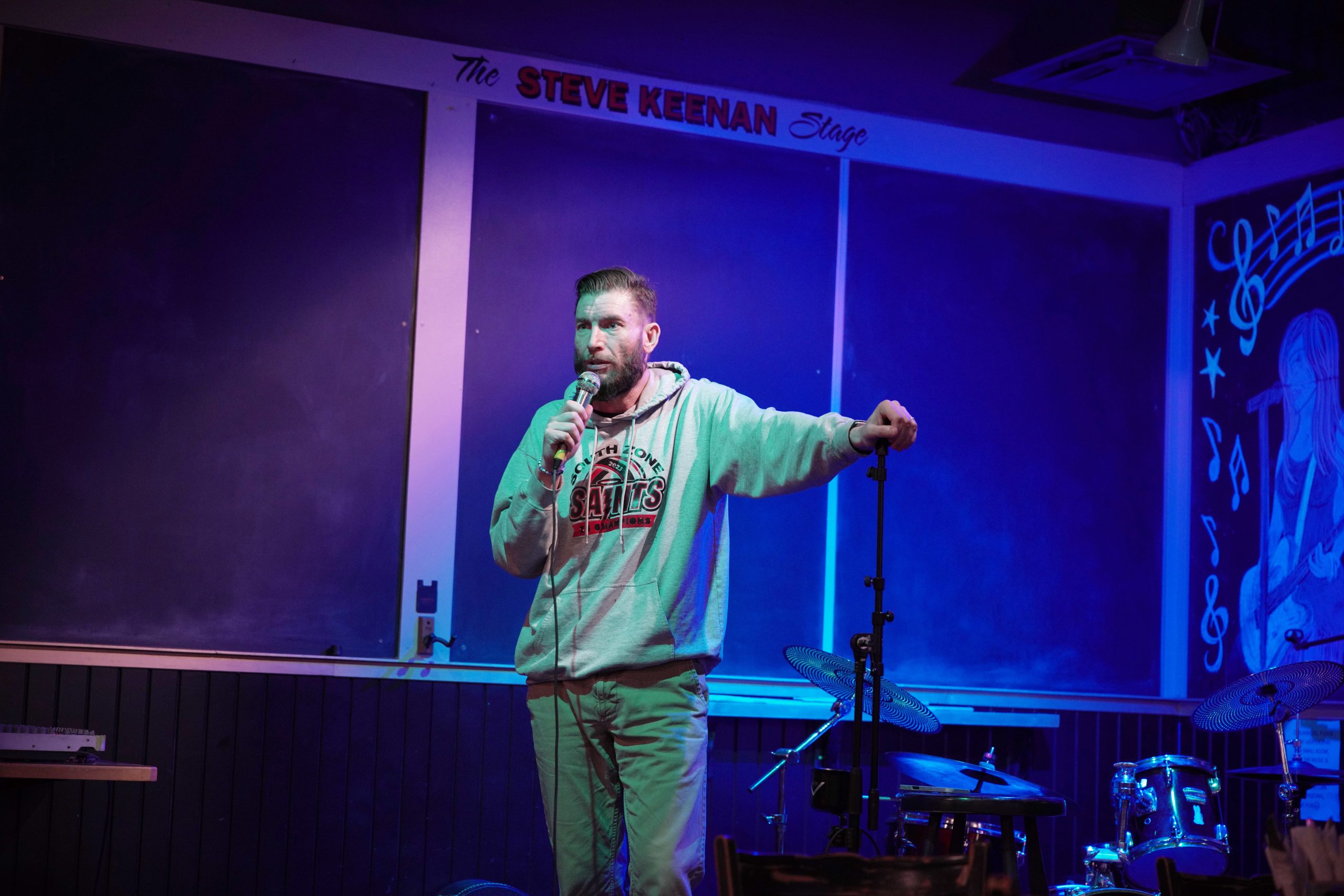
Brian Dawydiuk talking during a new open mic comedy show at Honker’s Pub on Feb. 24. Photo by Nelson Shekasana.
On the last Tuesday of the month, the lights are slightly dimmer at Honkers Pub and a microphone stand, in anticipation of a small but interested group, is set before the room.
The conversations fade away as a comedian walks onto the stage before delivering the first punchline of the night.
The resulting laughter is not just some form of reaction but it is a shared release. The new monthly open mic has become much more than merely another source entertainment event in Lethbridge, it is proving to be a friendly venue where new and diverse voices can test their content, share their stories with those in attendance and network with others.
To actors and even spectators, the performance serves as an occasion to leave the current realities of what’s going on in their daily grind and enjoy comedy as an act of identification.
This open mic features a combination of experienced performers and novice comedians who are up to the challenge and want to perform their material before a real audience.
Although there are some comics with years of experience behind the microphone, the format is deliberately low-pressure allowing beginners to step onto the stage without high expectations. The aim, according to the organizers, is not only to expand the number of comedic events in Lethbridge, but to establish an atmosphere of inclusion where individuals with a wide range of backgrounds, identities and levels of experience can experience a welcoming environment.
In a town where there may not be as much room to showcase creativity, the monthly performance is swiftly turning into a regular meeting place for creative expression, networking and mutual giggling. It’s a platform where everyone with a couple of jokes and enough guts to perform can find their voice.
Strater Patrick, a local comedian who performs under the stage name Strater, said open mics are designed to lower the barrier for anyone curious about trying stand-up.
“Open mics are super fun because they’re very flexible, low stakes,” Strater said. “That provides an opportunity, for new people, especially to come and try out comedy and, a safe and kind of come more comfortable way. There’s not going to be huge expectations on you.”
Strater, who has been performing slightly less than three years, said it is the environment that initially attracted him to comedy.
The open mics also offer a chance to be experimental, as compared to larger and ticketed events, in which performers might feel the stress to deliver refined work.
The comedians also get time to rehearse their jokes as well as to even learn through silence.
It is a first step into a world that can otherwise be viewed as intimidating. Instead they are hoping it can be an experience of learning and growth.
Strater also emphasized the importance of creating a space where performers from different backgrounds feel welcome.
“I like that our community right now is so diverse. We have women doing comedy and I’m gender queer. We have, you know, older people, younger people, people kind of from all different backgrounds doing comedy,” he said.
The open mic has united women, older performers, younger students and even gender-diverse comedians so in turn the shows have become diverse with experiences and world views.

Strater believes the best way of attracting audiences is what the stories are about as well as style of the well-constructed jokes and the authenticity.
The show also helps in bonding not only between the comic and the audience, but the comedians themselves by motivating each of them to be true.
This can serve to support the image of an open mic as an open and community-based platform to exhibit creativity.
Rebekah Keller, a comedian who has been performing for three years, described comedy as both an art form and a form of personal release.
“Well, I love the creativity, honestly. And the self-expression I do consider to be an art form and a little bit of therapy as well,” Keller said.
To her, the stage is like a release where she can turn her day-to-day stresses into a form of a story where people laugh and, at the same time, are able to relate to the people being performed to. Another point raised by her was the place of storytelling in stand-up, citing that, in most cases, jokes start with real-life events, which are transformed into funny stories. In addition to self-expression, Keller regards the open mic as a community event in which beginners are advised to give comedy a go, irrespective of their level of experience. Providing a combination of structure and improvisation, the performers can experiment with their creativity and involve the audience in some joyful and reflective moments.
Keller also emphasized the importance of welcoming first-time performers to the stage. “We always want new signups. Like, we always want people to come and, like, even if they have, like, three jokes. Just come up and try those jokes,” she said.
The nature of the open mic is to provide beginners with an opportunity to rehearse without feeling they can’t, and to build confidence as they learn to perform on stage. Keller believes the monthly show will become a reliable place where everyone with a sense of humour and ready to get on stage can be heard. It is very empowering for many who attend and have the chance to take part, at least for a short period of time.
The open mic promotes creativity, talent development, and community connection through a supportive environment, which, in turn, makes comedy more accessible to more people than traditional performance usually does.
Brian Dawydiuk, a teacher and comedian with 8 years of experience, described the unique tension and release of performing live comedy. “There’s nothing like that,” Dawydiuk remarked, trying to understand the tension in the process of giving a punchline and letting the audience respond to it. That moment of indecision, to him, is exhilarating and compulsive, and thus continues to propel him towards the profession.
On the one hand, Dawydiuk prefers premeditated content to control his performance carefully; on the other, he also explores the world of crowd work and improvisation, and each performance is another opportunity to practice his timing and delivery. The open mic format helps him try out new material with smaller audiences and in this case he gets the chance to get feedback and energy, which will subsequently shape the routines.
For an experienced performer like Dawydiuk, the stage is where one can discover oneself and interact with the audience creatively and humanly, through the artistic and human element of laughter.
For Dawydiuk, comedy is more than just performance; it has played a meaningful role in his mental health and personal growth. “I don’t think I end up where I’ve been on this journey, my mental health and everything without, doing comedy and just getting used to, like, you know, being, kind of open and honest and comedy,” he said. It is also his acting that enables him to cope with life events, overcome fears, and focus on creative experiences.
The open mic community, its warm nature, and the event’s format, which inherently provides a lack of pressure, create a space where a person can feel vulnerable and not judged, but instead connected.
This element of humour appeals not only to veteran performers but also to novices, who, in most instances, feel the need to tell their tales using humour as a confidence-building tool and an emotional outlet. Combining entertainment with self-reflection, the monthly performance highlights laughter as a social bonding factor and wellness tool, reinforcing the community-focused nature of the emerging Lethbridge comedy scene.
The open mic is also benefiting the local comedy community in Lethbridge beyond the growth of an individual. As social media grew, with the emergence of TikTok, people were exposed to stand-up and sketch comedy, and organizers reminded people to experience a personal bond.
Strater observed that digital clips cannot replace live shows, as these products can only inspire. The monthly show is also a training platform for upcoming comedians, offering them the opportunity to train in front of real crowds while learning the styles and techniques of their peers.
Regular long-term accumulation is a source of mentorship, teamwork, and friendship among performers. It also helps entertain the audience with a combination of humour, story, and moments they can identify with, not to mention that it represents the most diverse range of human experiences. By doing so, the open mic is not just a performance space, but also a cultural centre where laughter creates relations and enhances the city’s creative fabric.
The organizers hope the monthly open mic event will continue to grow and attract performers and audiences interested in playing in the comedy scene in Lethbridge. With performances at the end of every month, novices and seasoned comedians can refine their material, share personal stories, and engage with the audience.
Keller challenges those willing to perform to go out there, even when one has limited jokes. Strater also adds that the mix of performers by age, background, and identity is what increases the interest and liveliness of the nights.
The more people attend and participate, the more the open mic will be a source of local entertainment and the venue where creativity, laughter, and community intersect. The monthly show provides a welcoming, all-embracing environment for individuals who want to experience comedy or observe humor in its different forms.

Leave a Reply