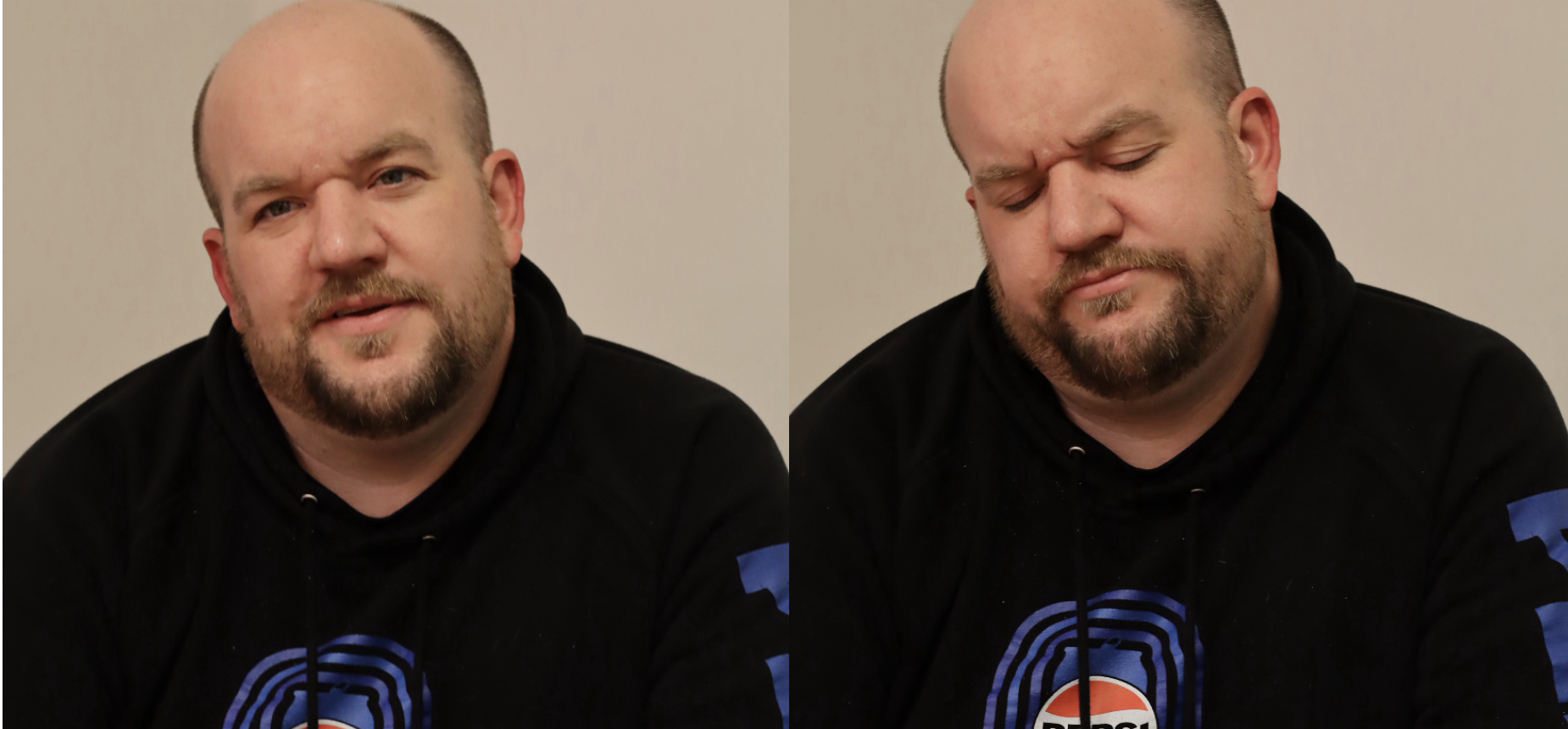
His voice brings a tone of relaxation and ease, but his intelligent eyes follow every gesture of the man sitting across from him. The years of training as an actor and the multiple performances on the stage have shaped him into a chameleon of many layers. He quickly changes expressions; he can smile and joke, while his mind calculates his opponent’s next move.
As he enjoys a weekend visit to the city where he used to live, DJ Gellatly is relaxed yet focused. He plays the logical game of cribbage with his childhood friend while exploring his emotions and memories, talking about his passion for the theatre and his journey in the performing arts.


Going back home after unsuccessfully attending university in Ottawa, he activated a reset button. Between the pressure of his father’s sickness and the support of his hometown at a job side by side with his best friend, it was the theatre that gave him the purpose and the sparkle of life once again.
“I just didn’t know what I really wanted to do. And then I had an old drama teacher from high school reach out to me, and they had lost a cast member two weeks before a show (…). And I did it and fell in love with acting again,” says the actor.
After his return, Gellatly studied visual and performing arts at the University of Lethbridge between 2009 and 2013 and was a member of the Lethbridge Shakespeare Performance Society during this time. Despite his love for the theatre, this was never his main source of income due to the uncertainties of a career in the arts.
Sheri Becker, Executive Director of New West Theatre, a prominent performing arts organization in Southern Alberta, says she understands performers’ challenges in working full-time in theatres. “Particularly in southern Alberta, there’s just not a lot of opportunity for full-time, consistent professional paid theatre acting contracts. So, we find that a lot of our performers who are located in southern Alberta will typically hold a full-time or numerous part-time jobs in order to be able to do what they love in theatre,” she says.
This reality is represented in the 2022 Canadian Artists and Content Creators Economic Survey Report (CACCES). The document highlights artists’ reliance on traditional sources of income, as more than half have a part-time or full-time job in another field. CACCES still shows that creative incomes are generally unstable and low. For 25 per cent of respondents, earnings from creative work oscillate 100 per cent or more annually.
Gellatly is a great example of it. He balances passion and responsibilities, working as a business development and account management specialist at Pepsico. When asked about how he has dealt with the uncertainties in the art-related job market, Gellatly calmly replied that he did so “by working outside of the art-related job market.”


Actor by vocation and education, businessman by profession, DJ Gellatly has always understood his acting dreams had to be kept separately from his financial responsibilities. “I’ve never been in a position where I’ve been able to support myself just from performing. There was a time when I was getting paid to act, but it wasn’t enough to live on,” he says.
The actor’s strategy represents a common dynamic amongst artists from the visual and performing arts. Alberta Alis, a government agency that offers career, learning, and employment information, states that “an actor’s life is rarely financially rewarding. (…) [M]any actors accept non-equity (non-union) work or work in cooperative productions. (…) Many actors must supplement their income between performances by taking part-time jobs unrelated to acting.”
Becker emphasizes that it is especially hard to keep professional performers in smaller cities, such as Lethbridge. Since the bigger the city, the more theatres and the more opportunities for performers, it is a very common occurrence to see local artists moving to Calgary or Edmonton, where the circumstances may be more favourable.
The challenges in the creative industry go beyond the finances. There is a mix of defiance and resilience, even to be invited to an audition, as networking is as essential and effective in this field as in any other. It is not a surprise, however, that constant rejection is as much a part of the process as a rewarding success.
“[T]he more people you know in higher positions in that sphere, the easier it’s going to be to get roles, to find out about roles (…). So, if you know what you want, you’ve got to go out there and grab it. You’ve got to deal with rejection a lot as an actor (…), not being afraid of hearing criticism and being rejected. You’ve got to have pretty thick skin,” says DJ Gellatly.
The path may be arduous, but it does not need to be taken alone. “I’ve always had a lot of support with what I do. Always,” Gellatly emphasizes. For those who do not find a support system amongst their family and friends, professional performing arts organizations and unions may be an asset to help secure a living from the arts.
The Screen Actors Guild – American Federation of Television and Radio Artists (SAG-AFTRA), a major American media professionals union, publicizes that having other jobs for financial support reasons, while performing, is common among actors. “Many actors earn income outside their chosen field. It’s common in our industry, due to the necessity of staying afloat financially,” says SAG-AFTRA.
In Canada, the Alliance of Canadian Cinema, Television and Radio Artists has a Performers’ Rights Society to assist associates with the collection and distribution of royalties, using collective agreements to ensure payments when productions are exploited in multiple media and markets. Nonetheless, the uneven share of profits in the industry remains a concern.
According to Statistics Canada, salaries accounted for only 23 per cent of the operating revenue of performing arts companies in the country in 2024, while operating expenses consumed the largest share, 87 per cent.

Still, despite budget limitations and financial instability, for professionals in the performing arts, the passion for the art remains the star of the show. As DJ Gellatly mentioned, the connections among actors, between actors and their characters and amidst the performances are the main and most rewarding elements on the stage. “If you want to be any good at acting, you have to have a psychological and emotional connection with characters (…) Continuity really matters and the people you are out there with matter.”
The chameleon Gellatly is changing once more. He is leaving his city and executive career and moving to Los Angeles. It is not the known “trades everything for your dream” story, but he is following his family and supporting his wife’s new career. That does not mean he will not take advantage of the opportunity at hand to reconnect with his passion.
This matches the executive director’s advice to young and struggling artists: persist to succeed. “I would say try to keep as up to date as you can for audition calls. So, whether that’s locally or province-wide, try to keep on the radar, be available for opportunities and apply, apply, apply, apply, go to those auditions and don’t stop trying,” Becker says.
The actor has plans to volunteer in local productions, even if as a consultant or advisor for marketing-related matters. He knows that artists do not give up, so he will use what he learned for the Arts and hopes to be seen on big stages or on the big screen in the future.