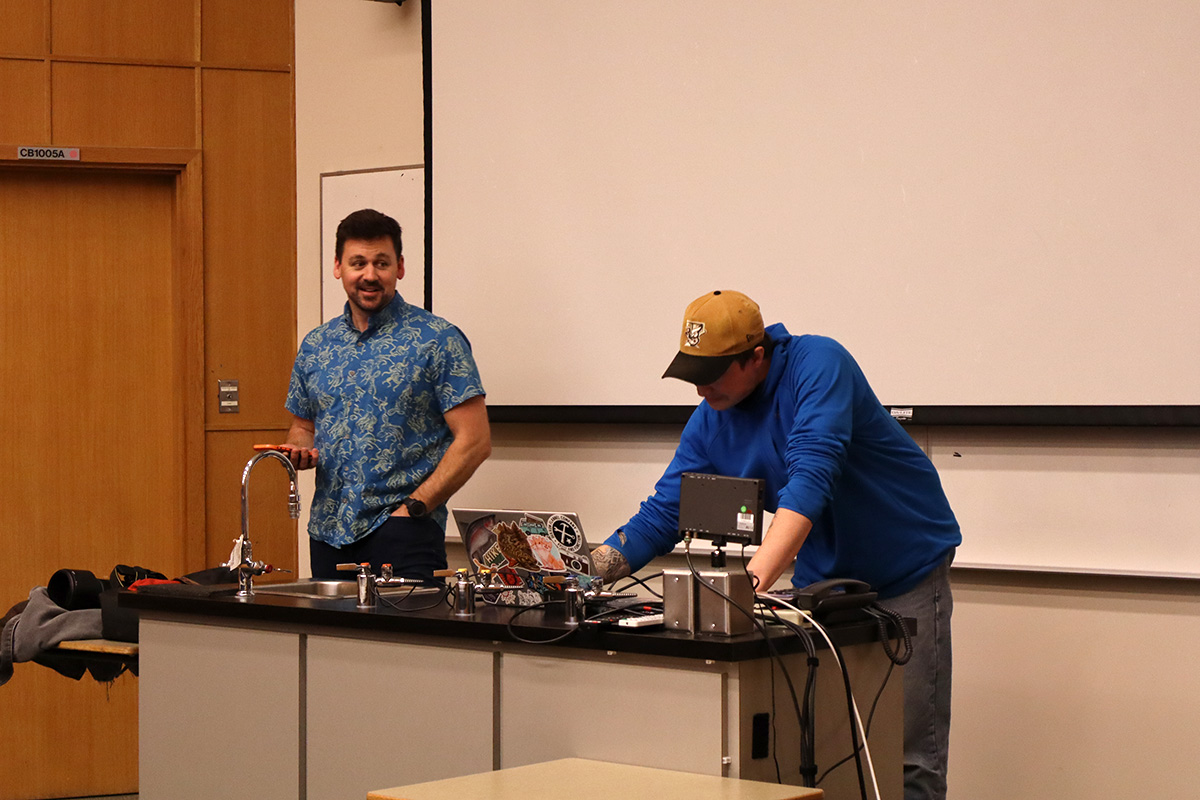
Everett Hanna, left, and Brandon Bart, right, preparing for Hanna’s speech at the Ecological Restoration Club film event. Photo by Sophie Swanson Blackstock.
Two documentary films related to the environmental impact of coal mining practices on the South Saskatchewan River Basin and the impacts of clearcutting on the BC interior were shared with students on March 27. The event was hosted by the Lethbridge Polytechnic Students Association Ecological Restoration Club.
But the Ecological Restoration Club is not just focused on showcasing films. They are also promoting a petition that aims to stop future coal mining practices on the eastern slopes of the Rocky Mountains in Alberta. The “Water Not Coal” petition was created by Corb Lund, an Albertan country singer.
Everett Hanna, a Lethbridge Polytechnic school of environmental sciences instructor who gave a short introduction about the films at the start of the event, says both those for and against coal mining in the rockies should have their voices heard.
“My stance has always been that it draws and pulls in both directions. That is, we need metallurgic coal for steel. And society obviously requires more steel because we keep growing and building more things out of steel. However, that does not preclude the necessity of environmental stewardship and responsible development of natural resources,” says Hanna.
One project that the “Water Not Coal” petition is aiming to stop is the Grassy Mountain Coal Project. This project was planned to be a coal mine that produced metallurgic coal near the Crowsnest Pass.
Brandon Bart, LPSA Ecological Restoration Club president, says that he understands the different perspectives involved in the coal mining discussion.
“I think that it’s important for us to see both sides of the coin. The people of Crowsnest Pass, they see it as creating jobs, which is totally fair. Us in Lethbridge are more concerned about the water,” says Bart.
When asked what he would like people to know about coal mining, Hanna wants people to know more about cumulative effects.
“The problem is that when we look at things as a patchwork and don’t consider the entire system as it is connected, and importantly as water is connected, we miss the mark and we don’t understand how these things add up through time,” says Hanna.
Those in Lethbridge such as the Lethbridge City Council have been against the grassy mountain project due to potential harm to Lethbridge’s water supply, which originates from the Rocky Mountains.
Bart says that the petition’s concern with the grassy mountain project is due to selenium, a byproduct of coal mining.
“There’s no way to remove [selenium] once it’s gone into the water, since it’s soluble in water. Once it’s in the water, it’s very hard, if not impossible, to take out. We already know what selenium does to fish, and it’s pretty ugly. If that’s what happens to fish when they’re in contact with selenium, what happens to humans,” says Bart.
The Water Not Coal petition is still seeking signatures as of the publication of this story.