
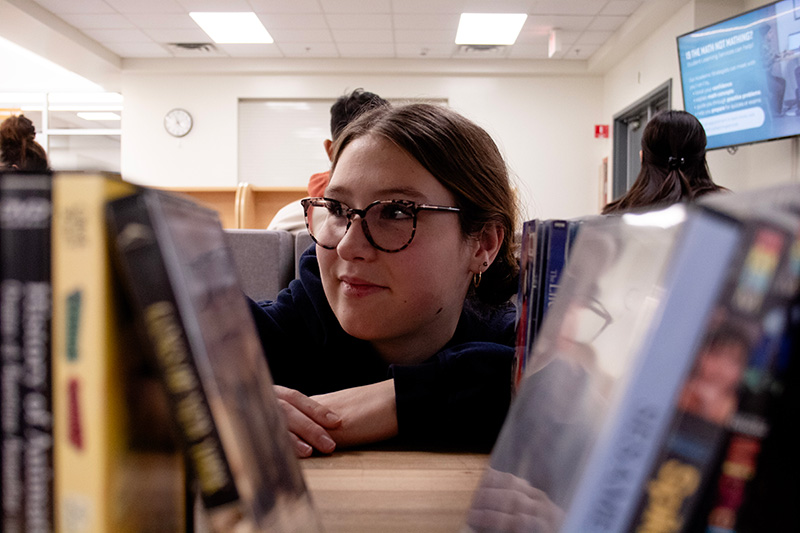
Whether it’s the fantasy world of Harry Potter, the To Kill a Mockingbird lovers, or those loyal to The Lord of the Rings trilogy, these readers have experienced worlds that the film fanatics will never understand.
Most bookworms will tell you it’s extremely important you read the book first before you watch the movie. Others will tell you that there is no comparison between the two. Adapting books for films is a challenging task when trying to please the avid readers. So, the question remains: what makes a book a successful movie adaptation? What aspects of literature should remain in literature and stay away from the world of filmmaking?
Brent Cottle, the Chair of the General Arts and Science Diploma Program talks about the task of adapting books to film. Consider what is gained and what is lost in the process of adapting books for film. Cottle says, “What’s gained, is a more immediate visual sense of the story. People respond so much to screens nowadays. The story develops a lot more visual presence and people respond a lot more to that sensual stimulation.”
Movie culture alone has significantly impacted what we read, how much we read, but it also has impacted how writers develop their books. Some individuals will pick up a book and, unless they are hooked in the very first chapter, won’t keep reading. This could be the result of movie storytelling and their fast-paced nature and therefore poses a challenge to writers and the creation of their opening chapters.
Award-winning and internationally published author of acclaimed writing guides, K.M. Weiland wrote an article in 2016 that talks about the difference between storytelling in books and movies. Her article, 5 important Ways Storytelling is Different in Books Vs Movies, talks about the movie industry being a unique medium with a “‘very specific type of storytelling.” While this medium can provide incredible opportunities for the storytelling process there is a key aspect of literature that is lost when developing an adaptation. The interior point of view (POV) of each character.
Cottle also says this interior POV is lost in adaptations. “Literature is really good at describing what’s going on inside characters heads, and it’s hard to do that in film…Literature can cover a lot of timespans in a fairly compact space.” Books that are heavily interior are a lot harder to adapt to film because of this POV.”
This part of literature is one of the most powerful aspects because it connects the readers to the characters in a meaningful way, by relating to their internal thoughts. Most importantly, writers aren’t at the mercy of time. They can choose how many books it takes to fully develop their plot, which characters readers follow along with internally, and so much more. It’s one of the most unique parts that sets both storytelling mediums apart.
An article written by FILMD, Adapting Books for Film: From Page to Picture in 2024 states, “readers often form deep connections with the characters and plotlines of a book, making it a tall order to do justice to the source material. In the face of these challenges, filmmakers find opportunities. The necessity of condensation forces them to distil the story to its core elements, emphasizing what’s truly essential.”
Authors don’t have to fully develop their characters into a two-hour movie or have all the conflict solved within a specific time frame. Whereas Cottle describes, film is directly in time and can only represent action taking place. Therefore, books that are heavy on action and plot development are better suited for a film adaptation than books heavy on character interiors.
A poll of a few young people reveals The Lord of The Rings is a popular choice for the best book to movie adaptation. 18-year-old Nina Visser, a book lover and a die-hard The Lord of the Rings fan shares her thoughts on why it’s one of her favourites.
“The whole world is so well thought out it’s so visually creative. It’s fantastic. The special effects in the movie, and the worldbuilding in the book. It’s so magical and I think that’s why I love it. Because it truly does transport you somewhere else…”
Magical is just the word creatives want to hear when they develop a new adaptation.
She talks about the special effects and the cast too. Casting is one of the hardest parts of creating a successful adaptation because the filmmaker’s worst critic is a bookworm’s imagination. “They stayed pretty true to the descriptors in the book but also spent so much time making sure they got everything right, like [the] special effects and moulding the cast to create them into these characters.”
But of course, there must be something wrong with it, right?
“[There are] barely any flaws. One flaw maybe from the book to the movie is that the book expands a lot after what happened, after the end, and there’s this cute little moment that I wish we could have seen in the movie, but they still ended it well. I guess I just wanted more.”
So, the biggest flaw of the amazing, action-packed film was that there wasn’t enough of it? The Lord of The Rings is about 9 hours of playing time and comes with 6 discs. It’s a big deal to say that there should have been more. She says that the films did an incredible job of transferring the key battle scenes into the story. It’s a lot harder to read about a giant battle, then to see the entirety of it before your eyes on the screen.
Visser says The Lord of the Rings “has created this standard for other live-action movies.”
Part of creating a movie adaptation is understanding that you are translating a story into a new language. A language that uses clear, visual pictures instead of letting the viewer form their own with their imagination. It’s what the film fanatics don’t experience. They don’t get the chance to build visuals of their characters and of the world within the book.
At the same time, there are huge opportunities when it comes to filmmaking because playing with the cinematography could brighten up the narrative and liven up the story. FILMD goes on to say that the most delicate part of adapting literature to film is “maintaining the essence of the original work while adapting it for the big screen.”
Therefore, it would be safe to consider that the start of the adaptation process should always begin with working to understand the heart of the story, the character arcs and their stories and each world (dependent on the genre). When it comes to developing a successful film adaptation, the filmmakers must choose the core elements of the story, such as the themes, conflict, tropes, etc. When they understand the most important elements of the story, it will set their film up for being an incredible adaptation that book lovers will love. Working with the author(s) and reading the book(s) they want to adapt, before starting on the film, would significantly impact the success of the film.
But film and literature are completely different mediums, and they should be treated that way. Literature will always offer a unique style of storytelling that film can’t put into picture, and movies too will offer a style of storytelling that can’t be revealed in books. So, it’s important that when you go to read the book or watch the movie, you judge them as what they are. A book and a movie.

Leave a Reply