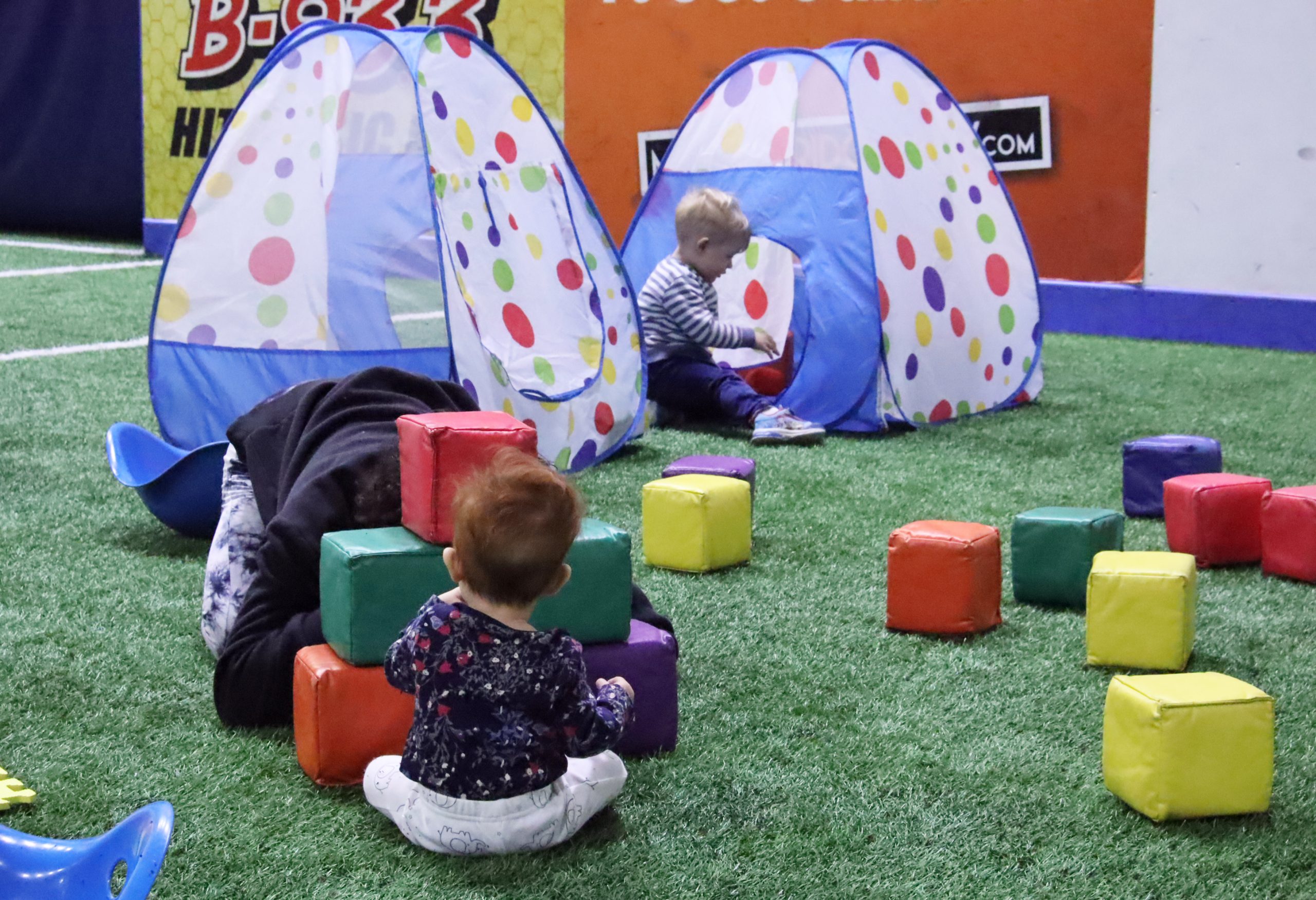
The sound of kids playing echoes around the large gymnasium. Giggles are mixed with tiny shoes hitting the rubber mats and slightly slipping on the floors. Occasional happy screams blend with shouts of friends’ names.
Two young moms share milestones about their babies and discuss their families – they became friends through attending these classes together with their little ones. Another mom plays with her five-year-old’s children. She says she is glad she found this place, because it’s great for kids to have a safe space to play outside of school.
Young children, from newborns to 5-year-olds, learn in a safe space that risky play can be fun and inspiring through the Roving Gyms program. Childhood lessons and experiences may help shape character and build social skills. They teach that losing can be part of winning and that falling can be part of rising.


Shawn Daye-Finley, Lethbridge Sport Council program and event coordinator, says the Roving Gyms is a non-structured program, so parents and caretakers are part of the play. The facilitators set up the equipment and supervise. It is all designed to stimulate children’s development in a safe environment.
“We’re basically there to supervise, make sure everybody has fun and then to help them engage in physical play to improve the fundamental movement skills, which improves the community’s physical literacy,” he says.
Cheryl Hatten, chair of the Early Childhood Education (ECE) and the Child and Youth Care (CYC) programs at Lethbridge Polytechnic, advocates for a holistic approach to children’s development that combines intellect and physical abilities. She emphasizes the contributions of a program like the Roving Gyms to address the challenges of physical literacy among young children.
“When children are there, they have the opportunity to not only engage in physical development and growth and activity, but they are among other children, so they get some of that social development, their learning aspects, again, their whole childhood is being developed. There are intellectual aspects. Can you throw the ball? How far can you throw the ball? Can you count how many jumps you’re doing? Things like that. And so, it’s great because the children can develop in that holistic manner,” Hatten says.
Both Daye-Finley and Hatten evoke the results of the Canadian Assessment of Physical Literacy (CAPL), published in 2018, which found that two-thirds of Canadian children did not have a satisfactory level of physical literacy.
“At a young age, with the advent of so much technology, there are lots of studies that show children aren’t getting enough physical activity… They’re sedentary … because they’re sitting looking at devices,” the chair of ECE and CYC says.


This is even more concerning because of its effects beyond childhood, which may impact the health of these individuals into adulthood and in their senior years.
“[There is] a big difference from a kid who comes and falls at roving gyms at two years old onward to the kids that sit on an iPad all day and then go to, they join in high school, let’s say Grade 10 or something, they’re joining my wrestling program, but they’ve never learned how to do that… The older we get, the more falls that happen,” says Daye-Finley.
The International Physical Literacy Association defined physical literacy in 2014 as “the motivation, confidence, physical competence, knowledge, and understanding to value and take responsibility for engagement in physical activities for life.” Therefore, developing physical literacy from an early age promotes a better understanding of space, movement perception, body awareness, spatial limits, consistency, and teamwork.
Joining a non-structured and free active play space, such as the Roving Gyms, from a very young age brings more than just physical benefits. According to Hatten, these “movement breaks” are essential for children, representing a key piece of their lives. They can help enhance social skills when children learn to surpass obstacles, to share and to get up after falling, so the play can continue.
Dr. Simon Schaerz, Exercise Science instructor at Lethbridge Polytechnic and Kinesiology and Physical Education adjunct assistant professor at the University of Lethbridge, is an expert and enthusiast in physical literacy. He considers physical literacy a developmental priority and believes that ensuring kids have all the movement tools contributes to blossoming their physical, emotional and social aspects.
“In neuroscience and psychology, there’s this idea around embodied cognition, where many of the cognitive skills that we develop as we grow are a product of sensory-motor type experience… Nurturing physical literacy early on has the benefits of developing the physical dimensions of health, but the overlooked aspects oftentimes are the emotional and cognitive aspects,” Dr. Schaerz explains.

Parents and caretakers are an extra layer of reassurance for young ones to explore this mini (yet potentially scary) world. The socialization aspect of purposeful play can foster connections between the young ones.
Hatten mentions that “hav[ing] children in a wider age range… [brings] the opportunity to develop empathy for the younger child and develop some of that social awareness and helping skills… [with] many developmental benefits for everybody.”
The adults may also gain from it by finding peers and socializing with people with similar experiences. Additionally, families learn how to better connect and assist in the growth of their young members.
“What do you want to do today to get better for tomorrow? … A little intention goes a long way in a child’s development. It’s not a great leap to put intention behind how you play with your kids. And I think that this program introduces parents to it. And once they get the idea, you can see the change right in front of your eyes,” says Daye-Finley, Roving Gyms coordinator.

PhysicalLiteracy.ca is a website about programs, partnerships, projects, best practices, research, leading-edge innovations, and opportunities within the physical literacy movement. It states that “kids who have fun playing a sport or taking part in physical activity are more likely to stay active and healthy for their entire lifetime. They are likely to develop a higher level of physical literacy and also have a better chance to pursue excellence in sport.”
Dr. Schaerz emphasizes that physical literacy comes with physical benefits as well as cognitive and emotional ones. He explains that a stable relationship with sports is more likely when varied movement skills are explored from an early age.
“Think about a building… You need to have a strong foundation… And that’s kind of the same thing, is if you don’t have that broad set of movement skills, later on, when you then try to perfect any one of those, it becomes really challenging. [O]ne of the key features of success in sport… is adaptability… from lots and lots of exposure with different things at a younger age… in the air, on land, in the water, and on slippery surfaces, ice and snow.”