Artificial intelligence has become one of the most controversial topics in the world today. Some people love it, and some people hate it. For some students and content creators AI is seen as lifesaver while for other people it is seen as a massive problem. AI can be used to help people generate interview questions, break down assignments and helps them brainstorm ideas for projects. Unfortunately, the same technology that helps people in so many ways is also being used to create deepfakes so realistic that it’s getting harder for people to tell what exactly is real and what is entirely fabricated. As AI becomes more powerful every day, it also becomes more complicated to trust.
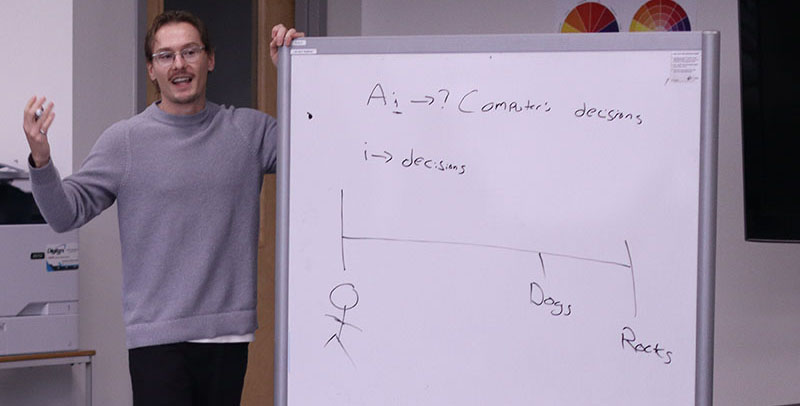
During a digital communications and media (DCM) class, Wesley Howery, co founder of Stratus ADV, a Lethbridge based technology company that deals with AI agents & workflows, software development and technology consulting spoke to students about the growing role of AI in our everyday lives and in the modern workforce.
Howery stressed the value of understanding how to use AI effectively. “If you can learn how to leverage these technologies, it’s going to give you a huge springboard coming out of college. Some people might like AI, and some might hate it, but in the next ten years it’s not going to matter. Whether you like it or not, AI will be part of our workflow.”
Howery explained that an important skill be it in school or in business is identifying the right problem before looking for a solution. “This is what I talk about with businesses a lot. It’s all about identifying the right problems. When you’re writing a paper, you have to ask yourself what’s the topic, what’s my thesis, what am I trying to communicate. Those questions are the first problems you’re trying to solve, and businesses deal with the same thing.”
For many people AI is like an assistant that has all the answers. Put in the right prompts and AI can be used to draft emails, summarize information, write up interview questions or even write up an entire essay. Tasks that used to take hours can now be completed in merely a few minutes. People no longer need to strain their brains researching for an interview or an assignment as everything can be done with the help of an AI tool.
First year Lethbridge Polytechnic DCM student Wayde Taylor feels AI can be helpful in many ways “I think it can be a really handy tool that speeds up learning new skills and finding information. It helps narrow down specifics and gives me a smaller range of resources I need to sift through.”
Taylor also believes that even if AI can be helpful, it should also be used responsibly “There are things that need to be safeguarded, especially information protection and the validity of what AI provides. I don’t use it to write papers for me I just use it to point me toward information I can look into myself.”
Even with all the positives, AI is getting far more disturbing. Deepfake videos have started popping up all over social media platforms. Fake videos with near-perfect realism featuring political figures, celebrities, and everyday people engaging in weird activities can be found all over the place. For the younger generation spotting deepfakes is a bit easy while the older generation are finding it very tricky finding the line between reality and fabrication. But even for the younger generation the line between reality and fabrication is becoming dangerously blurry. A convincing fake video can go viral in minutes, often spreading misinformation long before the truth has a chance to catch up.
DCM student Wacey Smith dislikes everything AI stands for. “I really don’t like it, I feel like the way were using it right now as a society, it takes jobs away and making people more lazy and less creative, and I love creativity.”
One massive controversy with AI is the recent issues in Hollywood. Movie studios have started to push boundaries by using CGI and AI to include deceased actors into their movies. Many fans raised eyebrows when an AI version of the late great Stan Lee was recently used for a promotional event.
These are all issues the younger generation can’t ignore, because they are the ones growing up and building careers in an AI-driven world. As the world evolves around AI, so does the responsibility to use it ethically.
Love it or hate it AI isn’t going anywhere. It will continue helping people write, create, communicate, and learn but it will also continue challenging people’s sense of reality. The question isn’t whether AI is good or bad. It’s how prepared are people to use it wisely.