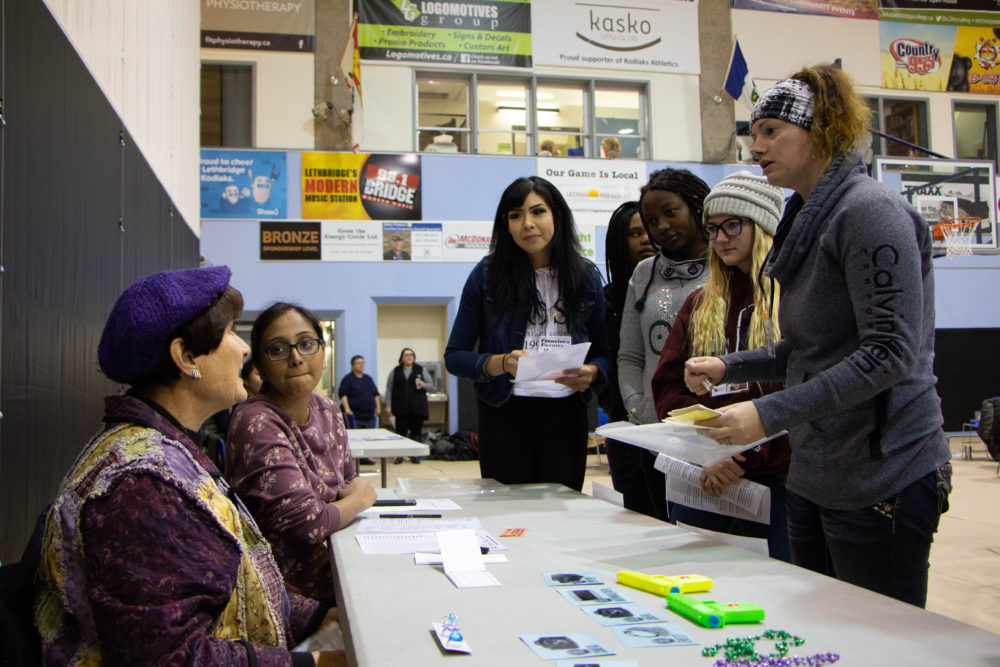
Students and faculty at Lethbridge College had the chance to experience a month in the life of poverty in just a few short hours on Wednesday.
The college partnered with the United Way to bring a poverty simulation to the college.
The simulation puts participants in families, and sets out different scenarios of transportation, employment and wealth.
The participants then had to attempt to survive four 12-minute weeks, all while maintaining a job, paying bills and buying food.
“A lot of students walk into [the simulation] feeling really confident and about halfway through they realize it isn’t as easy as they thought it would be,” explained Conolly Tate-Mitchell, a facilitator from the United Way. “A lot of the time, they leave the room feeling totally defeated and realizing how poverty affects them in so many different ways.”
In fact, not all of the 80 participants finished the 50-minute exercise without exhibiting any frustration. A few ended up leaving the gymnasium to take a break.
The simulation had a profound impact on many of the students and staff that participated, especially when Tate-Mitchell explained to the group that everything they experienced happens daily in Lethbridge.
Tate-Mitchell says around 12 per cent of Lethbridge residents experience poverty and numbers are rising. That equates to around 7,500 people.
It may be hard to see, but poverty has a presence inside the walls of the college too.
A joint study of 2017-2018 students at both the University of Lethbridge and Lethbridge College found large numbers of students at both institutions are struggling financially.
Eleven per cent of students cannot afford to pay their tuition, while one in five students are behind on their rent.
Despite both institutions offering relatively inexpensive health insurance plans, over 20 per cent of students need eye care but cannot afford it.
“A lot of students are going into jobs in their future where they will interact with the public and a lot of the people they will be working with will be struggling financially,” Tate-Mitchell says. “It’s important to be sensitive to situations that others are living in and not everyone is on the same path.”
Many of the volunteers that ran the stores, took on the role of police officers, or worked as bank tellers during the simulation were introduced to the event by participating.
The simulation was one of several events put on by the college during Poverty Awareness Week. Others included seminars about money management as well as inexpensive or free lunches and breakfasts.
The United Way holds three to four simulations every year and Tate-Mitchell says they are hoping to return to the college in the near future.
If you would like to see how you would fare in a month of poverty, there is an online simulator available at makethemonth.ca.