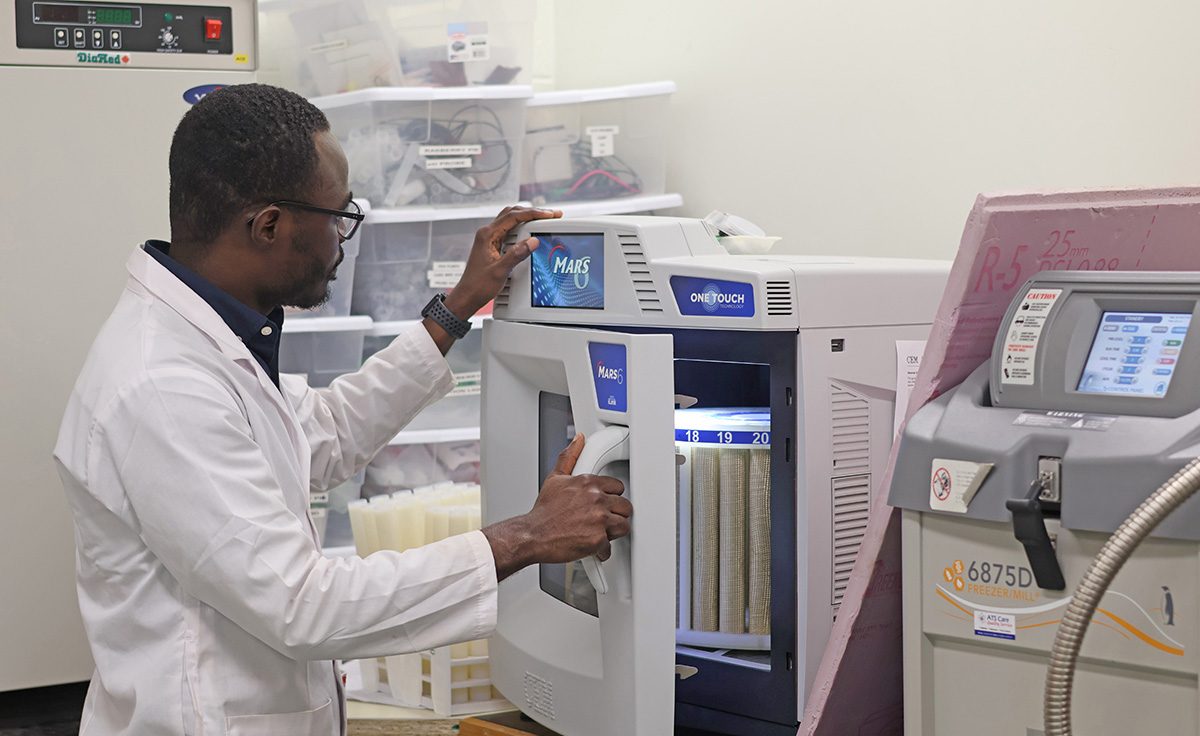
Emmanuel Nai, a research associate, loads fish samples for chemical digestion in a microwave digester at the Centre for Applied Research, Innovation and Entrepreneurship lab at Lethbridge Polytechnic. Photo by Patience Omeruo.
On a quiet afternoon in the lab, a research associate leans over a tank of shimmering water, watching the steady movement of fish in a tank, noticing tiny shifts most people would overlook.
Emmanuel Nai, PhD, a research associate at the Centre for Applied Research, Innovation and Entrepreneurship at Lethbridge Polytechnic studies how small changes, those barely visible details shape entire ecosystems.
Nai says small changes can create big impact.
“Aquaculture is full of small changes and small changes matter,” said Nai.
His instinct to look closer is something he traces back to Ghana where he grew up dreaming of becoming a soccer player. That dream might have taken hold if not for his grandmother, who pushed him toward education.
Nai says his grandmother’s guidance set him on a different career path.
“I really thought that was the plan, but she was the one who said, ‘Use your mind. It will take you further than your feet’,” said Nai.
So, he did. He enrolled at the University of Cape Coast in Ghana and earned a bachelor’s degree in chemistry.
Nai says his university years were a time of discovery and responsibility.
“I spent a lot of late nights in the library pushing through fatigue. It taught me discipline. If you wanted to learn, you learned, no matter the conditions,” said Nai.
After graduation, he spent a year teaching undergraduate chemistry as part of national service in his home country. That was when everything changed. A professor and alumnus of the University of Alberta noticed his potential and encouraged him to apply for graduate studies in Canada.
Nai says that single conversation was a life-shaping one for him.
“That conversation changed the direction of my life. Sometimes all you need is someone who sees something in you that you don’t yet see yourself,” said Nai.
Motivated by that conversation, Nai packed his bags and moved to Canada in 2018.
In 2024, he earned his PhD in analytical and environmental chemistry from the University of Calgary. He specialized in analytical instrumentation and stationary phase development and detection. His research sharpened the skills he now brings to applied research.
Today, thousands of miles from his childhood home, Nai leads a project that could change the future of aquaculture by exploring a simple but transformative question: Can we feed fish more sustainably?
Nai is investigating whether canola meal, the protein-rich material left over after extracting canola oil, can replace traditional fish meal in aquaculture diets. When completed, this innovation would reduce reliance on marine resources while opening new markets for Canadian canola growers.
Nai says the project will change the future of aquaculture.
“It sounds small but it’s not. When the trial is completed successfully, it will help farmers, support the ecosystems and create new value from something we usually ignore,” said Nai.
The project is funded by the Canola Council of Canada, Alberta Canola, the Manitoba Canola Growers Association, Sask Oilseeds and the Government of Canada under the Sustainable Canadian Agricultural Partnership.
Gregory Holmes, greenhouse facility manager at the Integrated Agriculture Technology Center describes Nai as calm and quietly confident.
“He works incredibly hard. He’s organized, thoughtful, always clear when he explains things and you can trust what he says. He’s very soft-spoken and easy to talk to. He brings a calm presence to the team,” said Holmes.
Nai’s technical expertise is evident in his ability to navigate sophisticated tools, analyze complex systems and implement effective solutions.
Holmes says Nai has extensive experience as an analytical chemist.
“He is essentially the chemist behind our lab. He knows the equipment inside and out, especially on the analytical side. There were moments in our trials where a single mistake could have set us back, but he stayed focused, solved the issue and we ended up with excellent results,” said Holmes.
Nai sees the project as being more than a scientific technique. It is about the people whose lives and livelihoods could be strengthened through innovation.
Nai says he is motivated by the people who stand to benefit.
“We’ll be able to show that this model of food production is sustainable. It supports farmers, strengthens the food system and creates new value for canola growers,” said Nai.
Outside the lab, Nai still finds time for the passion he never let go of, his love of soccer. He drives to Calgary for league games, finding in the sport the same discipline and joy that carried him through his studies.
“There’s still so much we haven’t explored,” said Nai. “The more we learn, the more possibilities we uncover for producers, for sustainability and for the future of agriculture.”
Visit lethpolytech.ca/CARIE to learn about Nai’s ongoing project.