
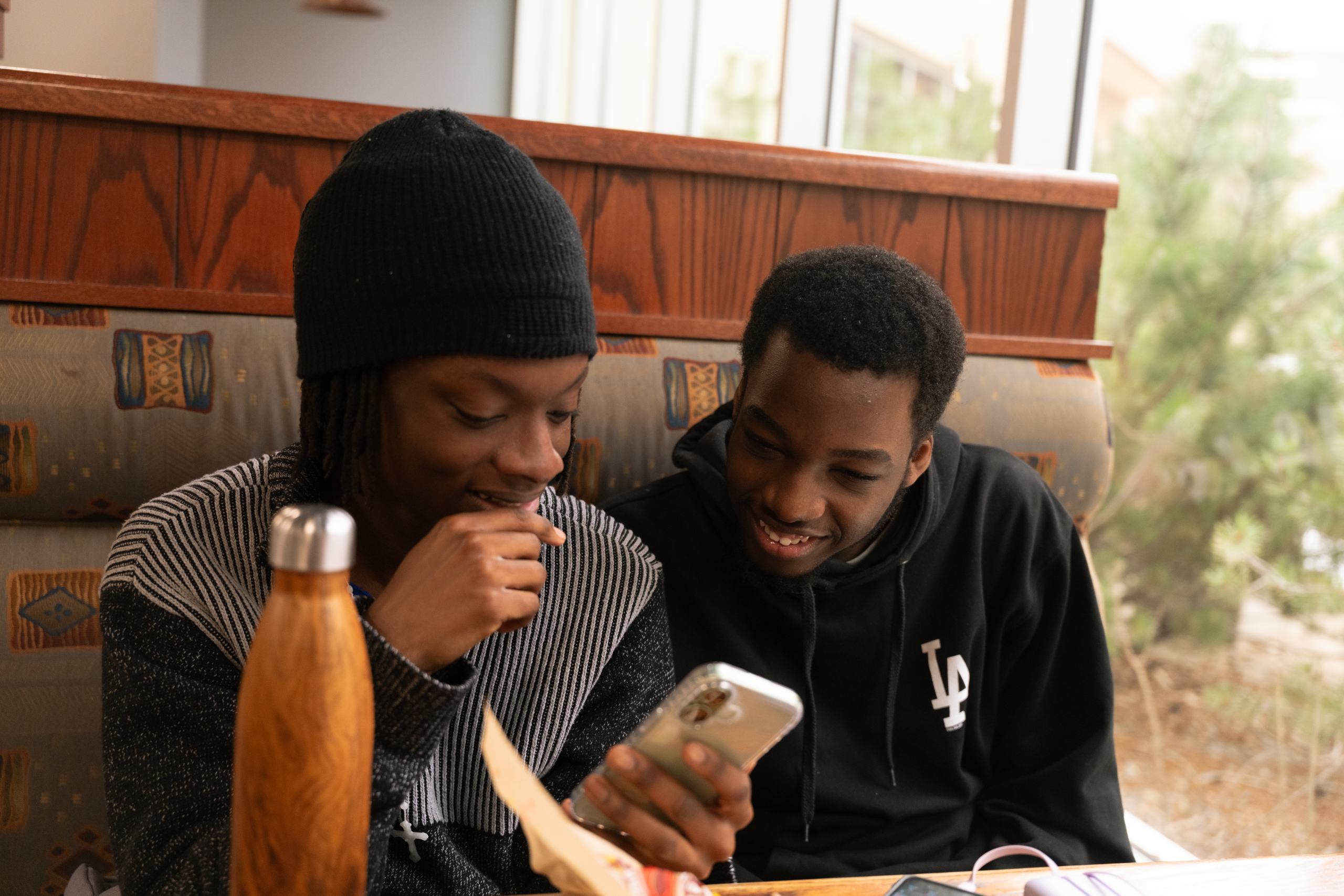
Lethbridge Polytechnic students Damilola Aladejebi and Richard Tackie wind down in The Cave at Lethbridge Polytechnic on Feb. 27 before heading to their part-time jobs amid the pressures of student life.
Photo by Somto Osinachi-Nnedu.
When one Nigerian Lethbridge Polytechnic student began to speak about her transition to Canada, her voice softened, but not with regret, but with hope, a better life.
Back home in Nigeria for Osato and her family, Canada represented possibilities, opportunities and what they call “green grass.”
“My whole story is a little different. I mostly left school because of an emergency. And then I wasn’t even working,” said Idugboe, who is taking the Registered Nurse program at Lethbridge Polytechnic.
At the beginning, her plan was clear. Her parents would cover the tuition cost while Osato focused on just showing up for school. Education was going to be her priority, not survival.
But circumstances changed back home, which led to tougher decisions being made.
“Yeah, I would say it was a mental toll, emotional distress, anxiety, deep sadness and seclusion, because high blood pressure is crazy at any young age, because people, both instructors and leaders, don’t even know people finance their tuition themselves.”
According to Muneer Nazam, international student coordinator at the polytechnic says it’s not very common for individuals to financially support themselves. “I feel they are not very common.” Said Muneer.
There is a lack of awareness of situations where Nigerian students pay their tuition themselves due to currency devaluation back home, the economic crisis, the death of a sponsor or even the death of a parent due to cancer during the mid-school session. Through this, they are left to grieve alone and still show up.
According to an article by Benedict Chidi Ugwanyi on the relationship between resilience and self-efficacy among the citizens of Nigeria, published on April 24, 2024, in Social Dissertations, “most Nigerians have some traits like recoverability and adaptability.”
This explains their ability to go through grief and still adapt without awareness of the people around them.
School is no longer about lectures and assignment deadlines, it has become something to drive them forward. They survive their course work faced with exhaustion, long work shifts and constant financial anxiety at a young age.
According to an article by The Government of Alberta on, the Economic and Social Impact of International Students on Alberta, published in May 2017, “International students alone in Alberta contribute $48,624,431 to Alberta’s economic growth from the 2015/2016 academic year.”
Osato begins her third year in her nursing education, two years of resilience, struggles and working more than her peers who are domestic students. Universities and colleges are collecting more funds from international students every year, with increases in tuition. At the same time, domestic students remain at a fixed rate, without knowing the struggles that go on behind the scenes. Struggles include where some people are left alone to cover this huge cost, one that costs $22,000 per year, three times the amount paid by domestic students.
“National students’ pay is to offset the difference that isn’t coming from the province, so if we weren’t getting any money from the province, every student would be paying that same amount because we’re getting money from the province,” says Branden Regal, finance advisor at Lethbridge Polytechnic.
She has never understood the disparity in what non-Canadians and Canadians must pay to get the same education.
“But they laid off some teachers from some jobs because they cut down international students who were funding those programs. Now nobody is taking those classes, so they had to lay them off; that’s basically the power international students even have. And with all that power, there are no perks, no student loans,” says Osato.
While students like Osato are left to work 24 hours a week to meet the cap given to international students to pay her tuition, rent, utilities, groceries and property insurance, she goes through mental and physical distress.
“I’ve worked four 12-hour shifts back-to-back in a production company. This one, my work, I cannot rest. There’s no such thing as sitting down. My sister called me. She said, what’s wrong with you? What’s happening? I was like, what’s happening? She was like, see your neck, you’ve lost so much weight.”
Without any access to loans or even scholarships, as many are provided to domestic students who pay less than international students.
According to an article by CBC News, Canada’s international student spike was blamed on private colleges. Here’s what really happened, published by Valerie Ouellet and Mike Crawley on Feb. 27, 2024 the international students felt left alone to be “cash cows” to their institution.
Advocates online have questioned “why does International students who sustain much of Canada’s education funding remain ineligible for loan programs,” because that could prevent a crisis from becoming a collapse.
Still, international students persist and are resilient, not because it is easy but because they believe staying here still means something. While this may sound ironic, that’s “the cost of a Better”, the better life and better dreams, it doesn’t come easy. It comes with sacrifices and seeds that spring forth a harvest. “It came with sacrifices to distance myself from my family, not seeing my parents and my siblings every day,” says Osato
There is a kind of pressure that comes from knowing your parents already initially sacrificed a lot for you to be here, some houses, lands and even a reduction in their cost of living to sponsor their child. When getting here, insecurity and financial crisis happen back home. This leads international students to improvise, take extra shifts, skip meals, fall asleep in buses on their way to work and still show up to class anyways.
“When you realize, oh, you have $1,000 bills to pay off. You can fall into depression and your blood pressure can go up. Suddenly, you’re not healthy anymore; it’s not just beyond what they are saying, it now becomes physical.” Osato says.
“Personally, the cost of a better life, I feel like it’s subjective. To me, it means distance from my family, my parents and some of my siblings.”

Leave a Reply